The prospect of a sudden shift in climate due to a rapid change in a key climate moderator such as the Atlantic Meridional Overturning Circulation (AMOC) has long worried climate scientists. But has their use of the term “tipping points” to instil some urgency into the climate debate and foster more urgent action backfired? According to Rutgers scientist Robert Kopp and his multinational team of colleagues, the answer is yes.
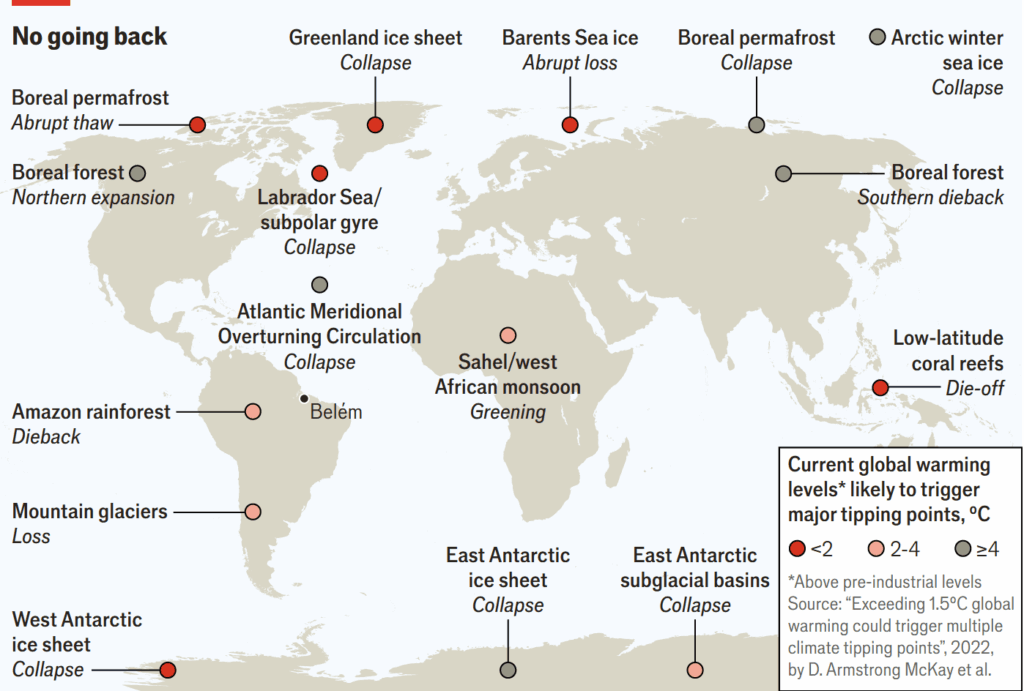
Several key tipping points have so far been identified. The work of Armstrong McKay et al (2022) attempted to identify the levels of global warming that might trigger individual tipping points. In the accompanying graphic you can see that the tipping points that appear most vulnerable are ice sheet collapses. The issue with ice sheet collapse is that the “collapse” is a misnomer, most likely taking decades if not centuries to play out.
This is one of the problems that Kopp and his team have identified. They say that “tipping point” implies “sudden” but many tipping points that are being discussed are not, so we run the risk of ‘crying wolf’ and no-one taking notice.
They argue that tipping points are not well defined. They say the term originally applied to “physical systems to describe irreversible, non-linear, self-amplifying and relatively abrupt changes driven by positive feedback dynamics.”
But the term has been adopted to label issues that don’t meet this definition. Examples include damage from sea level rise, increasingly unbearable heat or socio-economic issues such as mass migration, none of which are abrupt phenomena.
Kopp goes on to argue that the tipping point framing does not engender the urgency for climate action that some of its users desire. They point to social psychology which indicates that “anticipatory action (is) most likely (when) threats are perceived as relatively certain and (near) in space and time; by contrast, Earth system tipping points are diffuse, uncertain global phenomena.”
They go on to argue that tipping points are not useful in guiding climate policy and governance. A danger arises when a precise policy target, e.g. limit warming to 1.5 degrees, is conflated with precise physical thresholds of abrupt and irreversible change. Further, “if science is wrongly perceived as identifying precise thresholds for catastrophic outcomes when true thresholds are deeply uncertain, it may undermine the credibility of future claims should those catastrophic outcomes fail to occur when the perceived thresholds are crossed.”
Kopp offers five improvements to the tipping points narrative that better support climate policy and action.
First, clarify communication around tipping points. Researchers and communicators should be clear as to when they are simply invoking the term rhetorically – as synonymous with a threshold, a ‘point of no return’ or a metaphorical ‘straw that broke the camel’s back’ – and when they intend to invoke the full system dynamics analytical framework associated with feedback-driven, abrupt, irreversible change.
Secondly, capture deep uncertainty by using ‘low- or unknown likelihood, high-impact’ (LLHI) ‘surprise’ terminology.
Third, avoid tipping point terminology when describing how social transformations have and can occur.
Fourth, incorporate tipping point behaviours more appropriately in governance and risk management. This involves being specific about the actions different entities would take if they knew a tipping point was about to be crossed.
Finally, Kopp advocates continuing to employ temperature milestones as key policy benchmarks (such as 1.5 degrees) for motivating global progress toward a stable climate. These temperature targets should be acknowledged as policy benchmarks intended to limit cumulative harm, not inherent thresholds of the Earth system that cannot be exceeded without catastrophe.
Kopp concludes…
“Climate change is already causing demonstrable and obvious harm around the world. Despite tipping point discourse, there is no fraction of a degree that science can identify as the boundary between our current, already-dangerous climate and a future catastrophic climate. Appropriate policy reactions must recognize that every fraction of a degree matters.”
References:
Kopp, R. E., et al (2025). “ ‘Tipping points’ confuse and can distract from urgent climate action.” January. Nature Climate Change. 15, 29–36. https://doi.org/10.1038/s41558-024-02196-8
Armstrong McKay, D. I. et al. (2022) Exceeding 1.5°C global warming could trigger multiple climate tipping points. Science 377, eabn7950.
The writer is a co-author of Court of the Grandchildren, a novel set in 2050s America.
Main image credit: Hans via Pixabay
For posts on similar themes, consider:
Is Losing the Arctic Ice a Big Deal?