
Tree rings can be used to reconstruct climate records because they are strongly linked to summer temperatures in high latitudes and provide exact dating especially of extreme events. A new study1 about to be published in Nature provides a fascinating glimpse into climatic conditions in the arctic region over the last five hundred years.
The authors combined measurements of ring width and the presence of so‑called “blue rings” (BR) and frost rings (FR), which occur in particularly cold periods, to build a continuous chronology from 1526 to 2023 CE. Their goal was to place recent Arctic warming into a long‑term context, to test how well shrub rings record summer temperatures in coastal Greenland, and to examine how volcanic eruptions show up in both ring widths and wood anatomy.
Their Figure 5, reproduced below, shows the key outcomes of their analysis. Panel A shows the 498-years-long reconstruction of summer temperature variations (June-August) (as temperature anomalies from the reference period 1961–1990), against the overall mean of the dataset. Notable blue and frost rings are marked against the background of major Icelandic and global volcanic eruptions. Panel B shows the ice-core inferred non-sea-salt sulphur (nssS) records from Greenland.
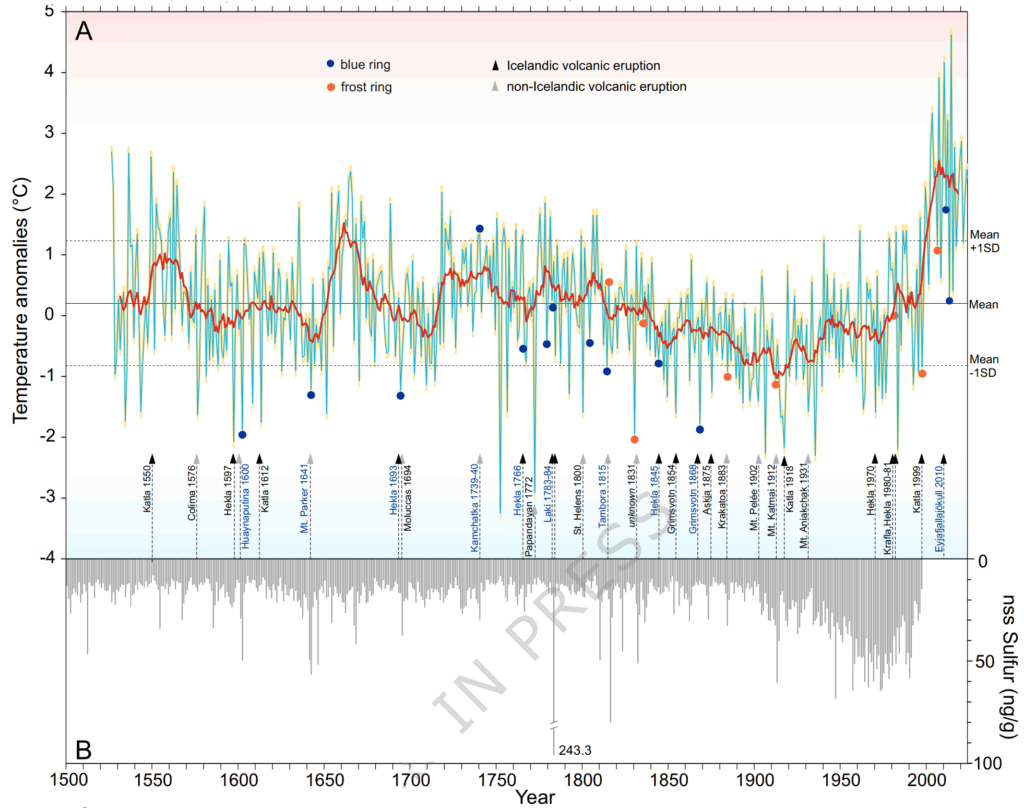
Over the full 498‑year span a long‑term temperature trend is not evident, but the 20th and early 21st centuries show a clear warming trend, with the 2000s and 2010s standing out as the warmest decades in the record (anomalies around +1.5°C relative to the 1961–1990 baseline). The reconstruction therefore shows that recent summer warmth in southern Greenland is unprecedented in this period.
Also clear from the evidence is that spikes in sulfur levels and plunges in temperatures (and appearance of blue and frost rings) correspond with volcanic eruptions. The most significant in nssS terms being Laki (Iceland) in 1783.
The ice-core sulfur data ends at around year 2000 but shows an increasing trend in the early 20th century compared to previous centuries, probably reflecting the massive increase in coal and oil use in that period. Then a reducing sulfur trend from around 1980 onwards possibly attributable to desulfurization of fuels and emissions in response to the acid-rain crisis. This period from 1980 also corresponds to the most significant increases in temperatures showing how atmospheric sulfur was providing a cooling effect. Proponents of geo-engineering for climate control often reference this observed effect.
The finding that recent decades are unusually warm in southern Greenland strengthens evidence for man-made influences and helps quantify the regional consequences for ice‑sheet melt and sea‑level contributions.
This paper is just the latest of many hundreds that remind us that man-made global warming is a real phenomenon that is sometimes obscured by noise, disinformation and self-interest.
The writer is a co-author of Court of the Grandchildren, a novel set in 2050s America.
Reference: 1 500-year paleoclimate record inferred from Greenland Juniper wood contextualizes current climate warming, https://www.nature.com/articles/s41467-025-66842-1
Main image credit: Pixabay
For posts on similar themes, consider:
Is Losing the Arctic Ice a Big Deal?