Imagine waking up to a world where your hard-earned career has been quietly automated away. It might sound like science fiction, but this transformation is already underway.
The rapid rise of artificial intelligence is fundamentally shifting our societal equilibrium. Because AI models are trained on accumulated human experience, they are gradually replacing traditional occupations. This will trigger a massive, invisible wealth transfer from human capital directly into the hands of a few tech giants and corporations, creating a potential powder keg for modern civilisation.
While short-term fixes like taxation and social benefits might help, the long-term outlook reveals a stark choice: as machines quickly master existing knowledge, humans may need to pivot toward generating brand-new discoveries and occupations to stay relevant. But what happens if humanity cannot keep pace?
We are in the midst of a digital revolution. How this digital revolution will end for humanity is far from certain, and earlier industrial and agricultural revolutions are poor guides due to the unique features of this current revolution. There is no shortage of books and commentators providing theories and viewpoints, but these can be difficult to digest and comprehend.
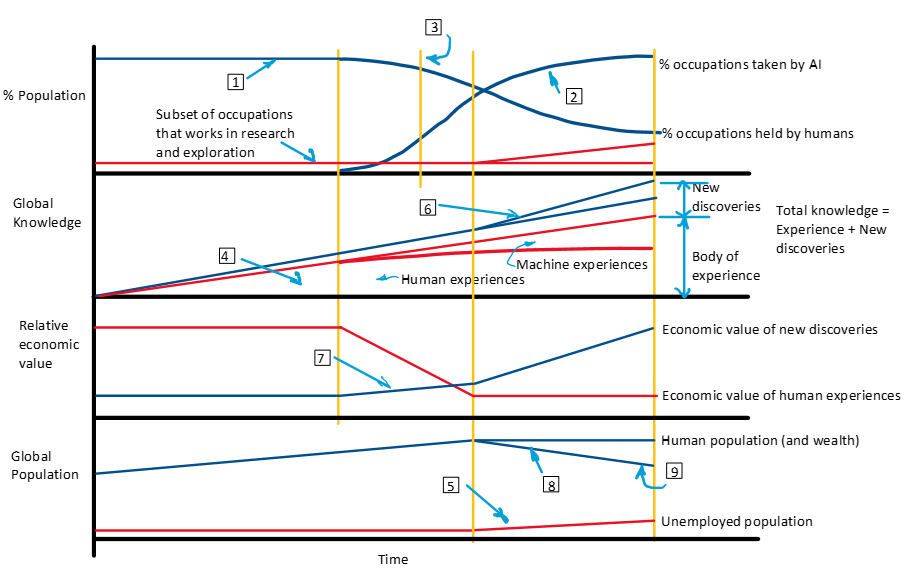
To help interested readers connect the various forces at play, I have developed a graphical model of one such scenario framed around an advanced western society, presented as charts with a set of explanatory notes. One conclusion of this model is the possibility of an ultimate population decline and social upheaval in response to rampant AI deployment. It is therefore a warning of the dangers if we leave this transition to chance.
The Model
Explanatory Notes
The following bullet points correspond to the numbers on the chart:
- Modern society has evolved and grown into a state of relative equilibrium where people fill certain occupational roles, such as plumbers, doctors, engineers, artists, etc. required for the society to continue to function cohesively.
- The rise of AI has fundamentally altered this dynamic. Society will shift to a new state of equilibrium, where more and more of these occupations will be lost to AI, resulting in fewer and fewer work opportunities for humans.
- Initially, this shift in dynamic will be imperceptible, but when the trend accelerates, there will be a backlash and a demand by people for compensation in some form. Our ability to demand compensation will hinge on the leverage we have on both the AI tech companies and on the government of the day. The greater awareness we have of this shift and its potential impacts, the greater leverage we can assert.
- The need for compensation is justified because of the enormous wealth transfer of the transition. AI is trained on human experience, and this human experience is being monetised, with the end result being wealth transfer from human capital to a few AI tech companies and those corporations which can largely dispense with their labour force. The imbalance of power resulting from this massive wealth and power transfer from human capital to corporations, if not addressed early and equitably, will have the potential to destabilise society.
- In the short term, humans may adjust to this wealth transfer and displacement of human capital by taxation, social benefits, and redistribution of human capital to other (or new) occupations. In the long term, as humans are displaced by AI, redistribution of human capital to other (or new) occupations will become more difficult, resulting in increasing unemployment.
- A potential human response to stem the rising unemployment is to expand the occupations that AI cannot replace. As AI is trained on human experiences, it is only able to synthesise new experiences within the confines of those known human experiences (i.e. it cannot think outside the box). However, human knowledge is made up of experiences and new discoveries. By devoting more human capital to research and exploration, we can generate more discoveries to feed into an ever-expanding body of machine and human experience.
- An economic force that will drive humans to new discoveries will be a shift in their economic value. Today, high economic value is placed on human experience because it is difficult and slow to acquire and accumulate. But as machines accumulate experience automatically and cheaply, the value of experience diminishes, and the society will shift to ascribe greater economic value to new discoveries instead. A strong government will be essential in ensuring that new discoveries benefit society as a whole rather than just the wealthy.
- The success of the human response to the rise of AI and its displacement of human capital is far from certain. A fundamental problem is that as AI improves at synthesising its own experiences, discoveries made by humans are quickly taken up by AI, meaning human capital can only be sustained if discoveries and their consequences grow faster than AI’s capabilities on existing knowledge.
- If this conceptual model is applied to all occupations that are at risk from AI, it seems unlikely that there will be sufficient new and expanding needs for human capital to fully offset the losses. If that is the case, a decline in birth rate will follow leading to a declining population and a reduction in average human wealth. An unruly decline and redistribution of human wealth will cause chaos in society as we know it.
Concluding Thoughts
The model highlights that the deployment of artificial intelligence must ultimately benefit society as a whole, rather than simply maximising profits for a handful of tech companies, major corporations, and their shareholders.
Managing this rollout without allowing an extreme imbalance of power and wealth to take root will arguably be the greatest test of our modern civilisation.
If your livelihood is vulnerable to automation, the compensation you can successfully demand will depend on the leverage you hold over both tech giants and the government. Navigating this effectively will require immediate collective action to maximise your influence and lobby for necessary legal safeguards.
Any meaningful framework for compensation and protection must look past immediate, personal financial hits. Solutions need to proactively account for the medium- and long-term consequences of humans losing purpose and status, alongside the broader societal costs required to successfully adapt to a new economic environment.
Calvin Lai is a civil engineer specialising in drinking water treatment who, inspired by the profound changes he has witnessed in society, is becoming increasingly engaged in social issues and advocacy for positive change.