
Modern society is heading steadily toward collapse. To avoid it requires us making some difficult short-term decisions. Are we capable of doing so? History suggests not. That’s the take away from Luke Kemp’s book, Goliath’s Curse.
Kemp surveys the lessons of societies on all continents over many millennia. He identifies the common threads that lead to formations of hierarchical societies, or what he calls Goliaths – “a collection of hierarchies in which some individuals dominate others to control energy and labour”.
Hierarchical societies do not form automatically. Kemp cites examples such as the Hadza and Khoisan as egalitarian societies to this day. He argues that Goliaths emerge under certain conditions which became more prevalent at the dawn of the Holocene when the ice age receded making localized agriculture more widely feasible.
The first condition is the presence of “lootable resources”. This could be in the form of stored grain or other food. The resource doesn’t have to be edible. It could be a strategic point on a trade route or a valuable material such as obsidian in prehistoric times, slaves at the dawn of colonization, or oil today.
A second condition was being able to secure and defend the looted resources which required a monopoly on weapons, ideally new weapons. Think warriors on horseback versus foot soldiers, muskets versus spears, nuclear vs conventional bombs.
But people couldn’t be oppressed by looting or military might if they could easily leave the domain. So, a third condition was necessary – a territory with few exit options. Kemp calls this “caged land”. An example of “caged land” in ancient times is Egypt – the fertile Nile Valley surrounded by desert.
Kemp refers to these three conditions – lootable resources, monopolizable weapons and caged land – as sources of Goliath fuel.
Another characteristic of humanity which became more prevalent in the Holocene was the rise of organized warfare, which was absent in the Palaeolithic Age. Kemp shows that three key ingredients for war were first, a large-scale organization, second, an inspiring ideology (or myth) and third, tight bonds between fighters. All are only possible in a hierarchical society.
However, history is littered with failed hierarchical societies. Kemp and his colleagues found that states were increasingly likely to fail over the first two centuries of their existence. Why do societies become more fragile over time? They found that inequality and autocracy increase as Goliath fuel increases, creating a vicious circle where a society becomes more extractive as inequality rises. But it can only go so far before the society becomes vulnerable.
Kemp calls this the Goliath’s Curse. One element of the curse is impoverishment of the masses which can lead ultimately to rebellion. At the other end of the scale, elite competition can cause dysfunction, coups and failure. As a society becomes more top heavy, the competition for high-status positions intensifies – the rich and powerful can stir up trouble if they don’t get their way. Further, as the controlling elite tended to be cushioned from environmental shocks, they were more likely to make bad decisions or postpone them in response to emergency situations – be they the threat of war, disease, drought or bad harvests.
That’s the theory, and Kemp comprehensively illustrates the concept by drawing on examples from the Bronze Age, the Mayan Kingdom, the cycle of the three Egyptian Kingdoms, the West African empires of Ghana, Mali and Songhai, and the Chinese dynasties, among others.
Let’s look at one example – the Roman Empire. It originated as a city-state republic which grew militaristic out of necessity. It went on to conquer neighbouring city-states and received levies and tributes – a highly profitable venture fuelling the desire to grow further. In the early days, Romans considered it their duty to serve in the military. Ten to twenty-five percent of adult men were deployed for combat and it came with significant honor and rewards. The Romans had mastered warfare or “monopolizable weapons”.
Eventually the empire would conquer Egypt which became its bread basket, and Spain, the source of its silver. Countless slaves were also brought to Rome from conquered territories providing low-cost labour. Rome came to depend on the fruits of conquest – lootable resources.
During this Republican expansion there was some semblance of democracy although this was a thin façade for the few dozen families that dominated the Senate, judiciary and governorships. As inequality and the power of the rich grew, the republic fell into empire with a coup by Julius Caesar. After a bloody battle for power another glorious period of one to two hundred years followed, but cracks had formed. Elites exploited the populace in governed regions, and inequality grew – people lived in a “caged land” unable to escape the empire. Several revolts took place including uprising by slaves which were cruelly put down. By the peak of the empire a third of economic output was owned by the top 1.5 percent of households and only about a tenth of Rome’s people beyond the wealthiest were living significantly above subsistence.
Corruption, a costly military (now made up of mercenaries), less profitable plunder and drying up of silver mines created a financial crisis. Taxes were raised and harsh laws put in place which led to crippling inequality and abandonment of land. The third century saw almost fifty years of civil war, and eventually Germanic mercenaries enacted a coup to end the Western Roman Empire, which dissolved into smaller statelets. The population of the city of Rome fell from around one million to 60,000 within a century.
So, how does the Goliath hypothesis apply to modern day society? Today the monopolizable weapons are nuclear, pushing the USA and Russia into superpower status. The lootable resources are fossil fuels. Fossil fuels, like grain, are concentrated, defensible, and easily monitored and stored. Also, like grain, fossil fuels are energy-dense and permitted a surge in population from one billion prior to the Industrial Revolution to eight billion today. And the “caged land” is the ongoing trend to urbanization. Most urban dwellers are totally reliant on inputs from outside the urban conurbation and on the service economy.
We are fortunate that the most powerful countries subsequent to the Second World War are, by historic standards, inclusive and democratic. As shown in the graphic, income inequality trended lower in English-speaking countries after the war until the 1980s. However, inequality has since increased, possibly corresponding to the rise of trade globalization and the deindustrialization of many western countries, directing income away from the bulk of workers and toward the elite.
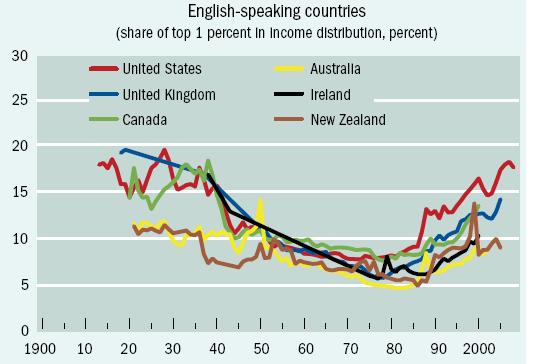
Kemp reminds us that the democracy and public services we take as being the natural condition of states (in the West) are actually an historical aberration. They are slowly being undone as the world drifts back towards the historical default of greater inequality, autocracy and extraction of wealth and power by elites. This in turn tends to lead to damaging in-fighting among the elite, at the expense of society’s overall interests.
Luke Kemp’s thought-provoking book provides a fascinating insight into the common causes of the rise and fall of hierarchical societies throughout history. He concludes that modern western society’s golden age has passed and that we face several existential threats such as nuclear war, climate change and AI that we are currently ill-equipped to manage.
The reviewer is a co-author of Court of the Grandchildren, a novel set in 2050s America.
Main image credit: beasternchen via Pixabay
For posts on similar themes, consider: