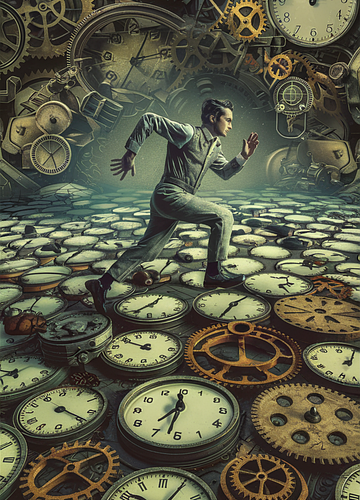
Human progress has largely been achieved during cycles of open societies which institute dramatic and transformative change followed by cycles of closed thinking which stills or even reverses progress. We are currently in an ‘open’ phase which is under threat from forces wanting to return to ‘simpler’ times. That is the well-argued and credible thesis of the book Open: The Story of Human Progress by Johan Norberg.
Norberg doesn’t formally define progress, but the context of his book suggests it is the growth in the average individual’s wealth and well-being and the reduction in extreme poverty.
As discussed in a previous post, Homo sapiens is a co-operative species. This gave us tremendous advantages over other species. With language it became possible to cooperate on a large scale and make use of the ideas, knowledge and labor of others.
As described in my post on Sapiens, a key outcome of language and cooperation was the initiation of trade and commerce. This gave rise to science which is built on the exchange, criticism, comparison and accumulation of knowledge and to technology which is its application to solve practical problems.
Humans innovate and imitate – rinse and repeat until we create something special. In the last two hundred years, life expectancy has increased from less than thirty years to more than seventy, and extreme poverty has been reduced from around 90 percent of the world’s population to 9 percent today. According to Norberg this has come about due to the intellectual and economic openness of this period which has supercharged innovation and brought unprecedented prosperity.
Present day globalization is nothing but the extension of cooperation across borders all over the planet making it possible for more people than ever to make use of the ideas and work of others no matter where they are in the world.
Looking back in history, Norberg identifies lots of golden ages of creativity and accomplishment. They happened in various places, epochs and belief systems: in pagan Greece, Muslim Abbasid caliphate, Confucian China, Catholic Renaissance Italy, and the Calvinist Dutch Republic. The common denominator was openness to new ideas, insights, habits, people, technologies and business models.
Norberg argues that under open institutions, people will solve more problems than they create. When people don’t need permission to experiment with new ideas, technologies and business models and are free to create and compete we see greater human progress.
Cooperation makes it easier to defeat those who don’t play well with others. In prehistory, every group had to find a way to protect itself against those who didn’t contribute but were happy to enjoy the loot. Thus we learned to distinguish “us” from “them”. Our ability to form new partnerships and alliances is so strong that we become loyal to new groups in an instant and we start to assume that our group is smarter, better and more moral than the other.
So we not just traders, we are tribalists. Both attributes are integral to our nature but push in opposite directions. One lets us find new opportunities, new relationships and new exchanges for mutual benefit. The other makes us think that others can only benefit at our expense (zero-sum thinking), which drives a desire to defeat others and block exchange and mobility.
This is the battle between ‘open’ and ‘closed’ we see today within the context of populism and nationalism. And it is not being fought between two different groups, but rather it is being fought within all of us, all the time.
The benefits of trade, which hard evidence shows to be substantial for both parties in the trade, come to us through creative destruction where old ways of doing things are destroyed so that we get things we want at a lower cost, and employ freed up capital and labour in sectors in which we are more productive. This creative destruction is what condemns free trade in the eyes of many people. One reason for this perception is that the costs are easier to see and they are more concentrated e.g. factory closures, but the benefits are more widespread. Nevertheless the costs are real for those impacted – when you are unemployed the unemployment rate is not 5 percent but 100 percent.
Detailed studies in the USA show that factory production today is two times greater than in 1984. One study showed that 88% of job losses were due to productivity gains like robotics which require less labour per unit of production.
And if you want to stop ‘cheap’ imports from a low cost global workforce and not reduce your purchasing power then you need to import a low cost workforce. America survived its nineteenth century protectionism phase only because it had open borders. But large-scale immigration is even more controversial than free trade.
Norberg gives many historical examples of the benefits of relatively open immigration. In modern times America was blessed by the intolerance and hatred of other cultures by other societies.
The history of immigration to the US dating from colonial days is consistent – previous immigrants equals good. Present immigrants equals bad. That is until they also become previous immigrants. The fear that people from countries with broken or oppressive institutions will recreate those in their new countries overlooks the self-selection of people who migrate. The simple fact is we get used to change, but admittedly it’s harder to get used to quick changes. Nevertheless we tend to underestimate the pace of assimilation.
There is a justified concern over potential job losses due to immigration but data suggests a net positive overall unless poor policy settings discourage work. Fear of crime is also high on the list of concerns. Actual data suggests crime does not increase but fear does. Culture change and lack of community is a legitimate fear that tends to be overcome over time.
Norberg describes how the Song Dynasty may have had the capacity to start the Industrial Revolution five hundred years early except for its fall and the closedness of the subsequent Ming Dynasty.
Similarly he describes the journey that caused the English to be the epicentre of the Industrial Revolution. The key reason was that compared to other European monarchies the British one was weak and unable to stamp its authority on its subjects. There was limited control of people movements or ambitions, allowing the private sector to step in and facilitate change. Entrepreneurs had predictability to achieve long-term pursuits through a fairer patent system, and mineral resources and property ownership rights. Successes built on other successes to modernize the economy and raise everyone’s living standards. Some argue that working conditions were terrible, and they were, but workers were three times richer in industrialized areas than rural areas. The overall increased wealth also funded improvements in conditions over time. In most ways the countries that won out were those that failed to impose control and order over their economies. Those who could, like Spain, lost out to those that couldn’t.
Norberg argues that progress is not a zero-sum game. Everyone benefits from developments and improvements in unrelated sectors because goods and services become cheaper and resources become available to sectors important to you.
He argues that the explosive rise of China was fostered by the opening up of the economy after Mao. But with this success Chinese leaders now want to control how people think and if they succeed they will undermine the contrarian creativity necessary for continuous novelty.
Progress is never progress towards an end goal after which we will live happily ever after. If that is our vision we will always be disappointed and interpret any remaining problems as a sick society. Progress is always two steps forward and one step back, because there is always push back and the inevitable mistakes have to be corrected. Both the left and right side of politics have a tendency to overuse control. In so doing we thwart genuine creativity and slow or even prevent progress.
The response to global warming is a good case study. One group believes we should wind things back and move to a zero-growth society. Another group believes that the problem can be solved if only we took certain actions. The past is littered with failed schemes based on predetermined actions – corn ethanol as a substitute for gas, renewables policy in the least solar-friendly countries. The correct response according to Norberg is the simple one of implementing a carbon tax that incentivises business and consumers to minimise harmful emissions including the distribution back to the population of tax revenues received. This approach should lead to the most efficient means to reduce harmful emissions. Of course there is a further difficulty of the group that argues that there isn’t a problem that needs solving.
One aspect of all human relationships which is zero-sum is that of social status. The wealth of most people can increase simultaneously with progress, but the status of everyone cannot because it is related to rank. And those whose status is threatened by progress will work against it.
In so doing they will want to revert to the nostalgic “good old days”. Norberg shows convincingly that every generation ends up pining for the “good old days”, but that there is no such thing. Surveys across multiple generations show that most people consider the period when they were young as the “good old days”.
Further, we become less tolerant and support enforcing “old ways” when the future is unknown (as it must be in an open society) and changes makes us feel vulnerable. This dynamic plays into the hands of would-be authoritarians or “stongmen” as we are presently seeing in several countries. Historically, economic insecurity creates a demand for conformity, rigid rules and ‘strong’ leaders.
Norberg convincingly shows that over the course of history, the meeting and interaction of cultures and ideas across borders opened minds and created great civilizations.
When looking at present living standards, health, wealth, literacy and liberty, there is no doubt that we live in a golden age. But history is littered with golden ages that did not last.
“The evolution that turned you and me into collaborative traders also turned us into status-seeking tribalists, worried about the advance of everybody else. This is the reason that open societies throughout history have… seemingly without warning slipped back into group warfare, nationalism and protectionism – even war.”
How do we prevent our current golden age falling into the same trap? Norberg suggests avoiding the excessive self-criticism by politicians currently waiting their turn to apologize that globalization has gone too far. Advocates of openness must avoid falling silent. Sure, opposition to popular reaction is hard but that’s why it’s so powerful.
Most importantly we need private citizens to speak up whenever someone is trying to strengthen the ‘tribe’ by peddling conspiracy theories and attacking scapegoats. Norberg reminds us that a single dissenting voice can open minds.
The reviewer is a co-author of Court of the Grandchildren, a novel set in 2050s America.
Main image credit: Maksymchuki via Pixabay
For posts on similar themes, consider: