If you read the news today, it’s easy to feel like humanity is hurtling toward an inevitable ecological collapse. It is hard to avoid doomsday headlines warning us of runaway climate change, vanishing forests, and oceans choking on plastic. For many, this narrative breeds “climate anxiety” – a sense of dread that convinces us it is already too late to save the planet.
But what if the data tells a different story?
In her book Not the End of the World, scientist and author Hannah Ritchie gives us reasons to be optimistic about the future without downplaying the severity of our predicament and the hard decisions ahead.
Ritchie is part of the Our World in Data team which runs an excellent website that publishes “research and data to make progress against the world’s largest problems”. As a result, Ritchie’s discussions and conclusions in her book are firmly grounded in real data.
Ritchie starts by defining sustainability as comprising two parts – meeting the needs of the current generation, while not compromising the needs of future generations. She argues that our ancestors were never sustainable because of high child mortality, disease and poor nutrition. But her book’s focus is on the needs of future generations.
Starting with the issue of overpopulation, Ritchie tells us that we have already passed “peak child” (in 2017). Global population will peak and then fall when these children reach old age. So, population growth is moderating and will fall.
Her chapter on climate change recognizes the progress that has been made on carbon emissions. Most developed countries have decoupled economic growth from carbon emissions. As an example, the United States real GDP per capita has grown 55% since 1990 while trade-adjusted emissions (allowing for trade and offshoring) have reduced by 14%. In a further example she shows that her carbon footprint (living in the UK) is half that of her grandparents.
Nevertheless, she concedes that the 1.5-degree Paris target is now unachievable, even though per capita emissions have peaked. She believes that more likely than not we will pass 2 degrees by 2100 but perhaps not by much. We are still some distance from a 2-degree pathway so efforts need to be stepped up quickly.
She believes that renewables and nuclear energy will be required to wean us off fossil fuels for heat and energy. For transport, biofuels are actually a net negative, electric cars will be the way of the future, but long-distance transport and some industrial processes still need innovation to make progress.
From a big picture policy perspective, Ritchie believes a carbon tax with collected funds redistributed evenly back to households would be the most effective policy.
In any case, we still have to adapt to a warmer planet. Ritchie advocates for improving the resilience of crops, reducing poverty as the most vulnerable are at greatest risk, and perhaps controversially, improving access to air conditioning (despite the increased energy demand).
Finally, she busts some myths about individual climate action. The following might make you feel better but have a negligible impact on carbon emissions: recycling plastic bottles, replacing old light bulbs, eating local or organic food, non-plastic straws.
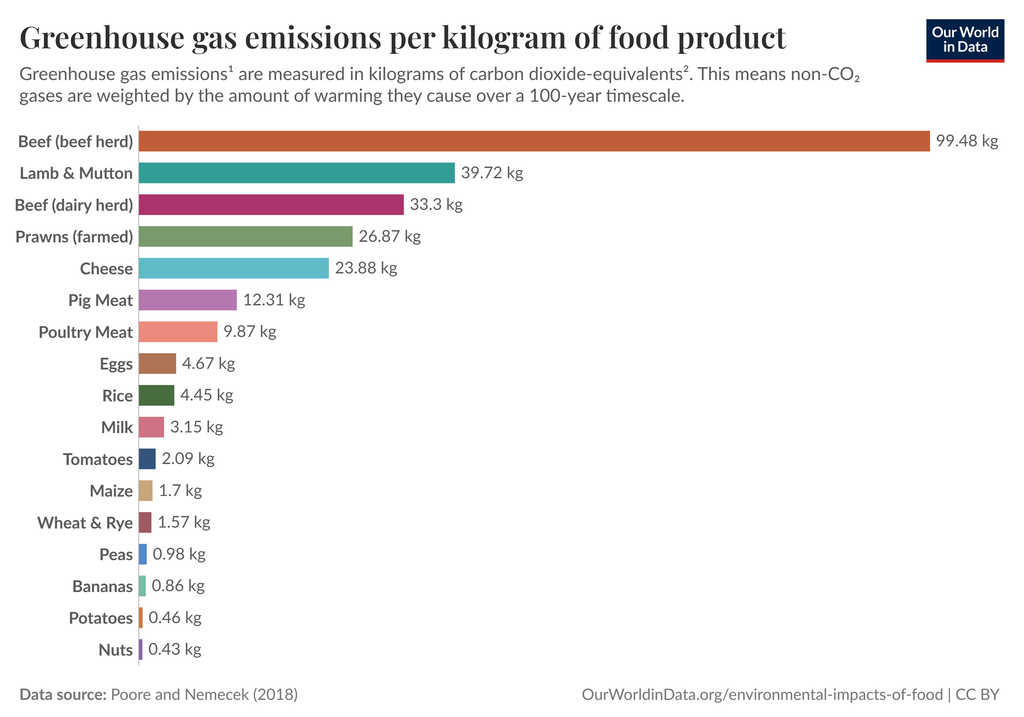
The most important chapter in the whole book is probably the one on food. Nearly half of all habitable land on the planet is used for agriculture. Three quarters of that is for grazing or growing feed for livestock. But the conversion of crops into meat is poor. It takes 100 calories of feed to produce 3 calories of beef or 4 calories of lamb. Chicken is four times more efficient and has a significantly lower carbon footprint as shown in the accompanying graphic. Meat and dairy alone contribute to around 20% of total carbon emissions.
Right now, the world produces more than two times the amount of food we need to survive. This is possible because of the use of fertiliser and crop breeding improvements. Ritchie says that despite the negativity associated with industrialised crop production, it is needed to maintain adequate food supply. Organic methods are not nearly efficient enough.
The key steps the author suggests for sustainable food supply include improving crop yield gaps in Africa and South Asia, eating less beef and lamb, investing in meat and dairy substitutes, and wasting less food. On the latter, Ritchie makes the point that plastic packaging provides a net benefit by reducing food wastage.
Other chapters in her book cover air pollution, deforestation, diversity loss, ocean plastics and overfishing.
A short summary like this one does not do the book justice, as Ritchie spends much time explaining why certain surprising positions she takes are justified.
In the end, the message is to stress less about the minor things and focus on high-impact changes: Eat less beef and lamb, vote for politicians who are pulling in roughly the same sustainable direction (perfect is the enemy of good), and, above all, refuse to give in to despair.
You may not agree with all of Ritchie’s conclusions, but she makes a good case that our generation has a historic opportunity. For the first time ever, we have the tools, the knowledge, and the momentum to leave the planet better than we found it. It is not the end of the world; in fact, it might just be the beginning of a sustainable one.
The reviewer is a co-author of Court of the Grandchildren, a novel set in 2050s America.
Main image credit: geralt via Pixabay
For book reviews and posts on similar themes, consider:
How to Cope with Climate Anxiety
How to talk about Climate Change
The best thing you can do to tackle global warming