
Two massive forces are combining to disrupt the world and societies as we know them. Analogous to The Fujiwara Effect, named for the combinatory effect of two hurricanes, author Viktor Shvets sees the forces of an accelerating Information Age together with the loose capital of a highly Financialized global economy having a transformational effect on the world as we know it.
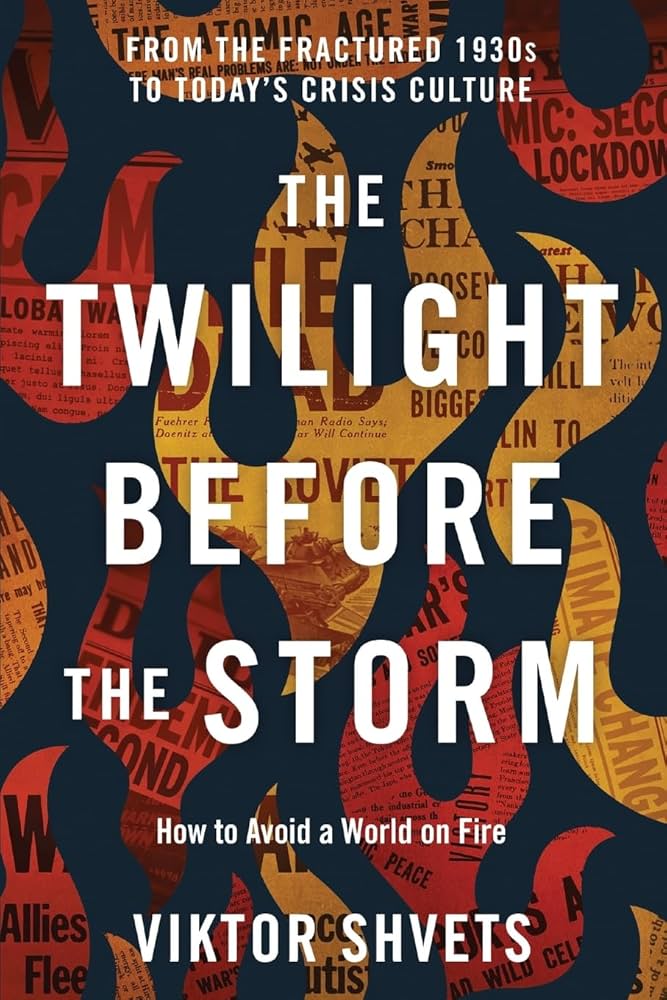
In his book, The Twilight Before the Storm, Shvets see parallels between today’s world and that of the 1930’s. In those times of disorientation and rising physical and economic insecurities “the thin veneer of civilization tends to fall off and raw primitive emotions resurface.”
In the 1930s, with the great depression in full swing following a devasting world war and flu pandemic, there were three options available to solve people’s mounting problems: communism, fascism or a constrained democracy. Communism offered the total elimination of private property and political rights in exchange for stability and equality. Fascism allowed one to keep their property but the private sector was directed by the State and democracy was exchanged for economic stability. The constrained democracy on offer from Roosevelt’s New Deal and others, was democracy with some reduction in freedoms and a bigger role for government – considered overreach by some.
Shvets claims that democracy is “not a natural state…and must be constantly nurtured by lowering inequalities” which get worse otherwise. He quotes the historian Polybius who believed that political systems rotated from monarchy to aristocracy to democracy and around again, each phase degenerating to create the next.
Today, less than thirty percent of the world lives in a legitimate democratic country (down from 50% ten years ago). The current pressures are an outgrowth of deep Financialization turbocharging the Information Age. The toxic intersection between these two powerful forces is compounded by economic policies over the last three decades which prioritized growth and wealth creation while permitting environmental degradation, growing inequality and defanging of state power and legitimacy – free markets rule!
According to Shvets, this has come about from the rule of the Baby Boomers who never experienced the hardships of the 1930s and couldn’t appreciate the compromises made by previous generations who sought stability as a priority. That stability from the 1940s to the 1960s featured some of the fastest ever productivity growth rates, middle class creation and decline in inequalities. The Boomers instead experienced the negative effects of government overreach – strict moral and societal values and embedded discrimination and hierarchy. Through neoliberal policies, they sought greater freedoms and from the 1980s embarked on a three-decades long dismantling of government and state functions creating a world “more entrepreneurial but less equal, more tolerant but less fair” leading to environmental degradation and significantly weakened institutions of state.
Today these neoliberal economic and political policies are discredited in the eyes of both younger and older generations. No consensus on how to go forward is fully formed. Shvets believes a long period of instability lies ahead not dissimilar to the 1930s when people were reaching out toward extreme political and economic models.
Millennials and Gen Z will become the majority demographic within five years and therefore will become the most influential political block. How we get through the forthcoming transition will be determined by this generation of leaders. They will determine whether we are in for the “world on fire” of the 1940’s or the “cold wars” of the 1960s. In either case, we will have to navigate the complication of the “hungry wars” brought on by climate change which will lead to the biggest tide of immigration that the world has ever experienced.
However, Shvets is optimistic over the longer term (probably sometime in the 2040s) when new societal norms will be established. Among the measures that he believes are coming (or should come) are a Universal Basic Income, necessitated by the rapid advance of Artificial Intelligence and Robotics, restructured education, and some reduction in freedoms – all leading to a greater role for the State, with guardrails placed on the private sector.
Shvets historical review of the path from the 1930s to our current state is compelling and worth a read on its own. His forward look and views on the likely or necessary future policies are so out-of-kilter with our recent experiences and norms that they can be hard to fathom. But perhaps that’s the point. Some rapid and uncomfortable changes are coming.
The reviewer is a co-author of Court of the Grandchildren, a novel set in 2050s America.
For book reviews and posts on similar themes, consider:
The Invention of Infinite Growth