If you’ve spent the last few years wondering whether the world is coming apart at the seams, you’re not alone. In his book End Times: Elites, Counter-Elites, and the Path of Political Disintegration, author Peter Turchin argues that societal breakdown follows patterns. And, if his models are right, we’re living through one of those patterns right now.
Turchin co-founded a field he calls cliodynamics: the attempt to treat the rise and fall of societies as a subject for quantitative science rather than pure narrative. His models are based on data drawn from more than one hundred cases studies of failed societies through history.
The key conclusion from his models is that two main factors predict a society heading towards crisis. Turchin labels these factors “popular immiseration” and “elite overproduction.”
Popular immiseration occurs when ordinary people’s living standards decline relative to the cost of living, even while the overall economy grows. Wages flatten, housing and education costs climb, and the gap between effort and reward widens. In modern times this can be measured by the proportion of wealth or income derived by the richest 1% versus the bottom 50%. A proxy measure for ancient times is people’s heights as determined from skeletal remains. Heights are a direct indication of people’s living standards and wellbeing.
Elite overproduction occurs when societies train and produce many more wealthy, credentialed, status-seeking people than there are elite positions to absorb them. In modern times these positions include corporate leadership roles, political offices and prestigious professorships. He notes that polygamous societies tend to cycle through crises more regularly than monogamous ones because of the greater proliferation of heirs.
Connecting the two factors is what Turchin calls the wealth pump: a set of economic and policy conditions that quietly siphon income and wealth from the broad population upward to those already at the top. As the pump runs, non-elites get squeezed while the ranks of the wealthy and aspiring-wealthy swell. Eventually you have a large and growing population of frustrated, ambitious people with no legitimate outlet for their ambitions, sitting atop a large population of people with genuine economic grievances.
That combination, Turchin argues, is the tinder for political instability and violence. These conditions are exacerbated when they are accompanied by a state running out of money, geopolitical pressure, or pandemics/climate change. They lead to a crisis period he refers to as the disintegrative phase.
To resolve such a crisis relatively peacefully, living standards for ordinary people have to be improved by granting them access to a greater share of overall wealth, and the numbers of elite have to be cut by reducing their wealth sufficiently to relegate many of them to ordinary status. This requires enlightened and self-sacrificial action from the elites such as occurred in the New Deal/Post World War 2 environment in the USA. Failure to do so leads to violent revolutions or civil wars where the changes are forced upon the participants.
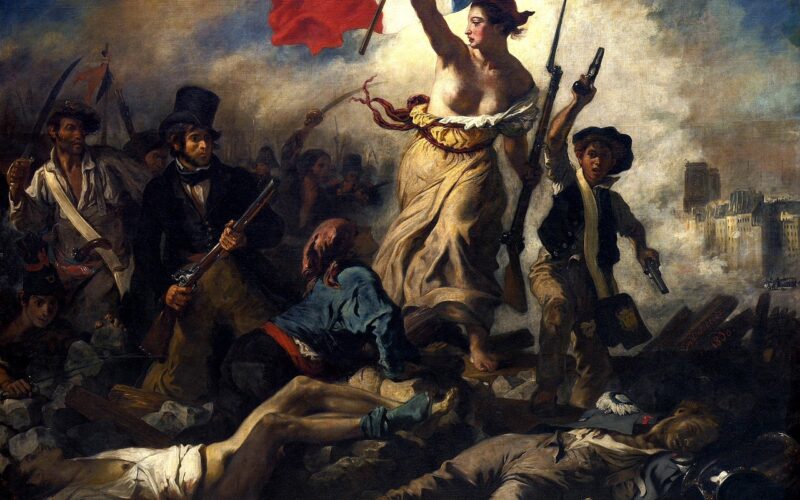
Turchin uses historical examples to illustrate the phenomenon. One example is medieval and early modern France, where the proliferation of minor nobility with accumulated wealth but no productive role fed centuries of unrest, leading to declining living standards and the French Revolution of 1789 and subsequent revolutions in 1848 and 1871.
But the most interesting case study is America because it provides examples resolved by civil war, and later by proactive reform. And our current circumstances have similarities to those preceding those crises.
In the first half of the 1800s, as the U.S. industrialized, the economic benefits were not spread equally. Using the number of lethal riots is one measure of popular immiseration, there were thirty-eight lethal riots in the five years before civil war compared to only one in the 1820s.
A new class of merchant and industrial wealth emerged from the industrial boom, and many sons of these families funnelled into law and politics rather than trade. A swelling generation of lawyer-politicians competed for a limited number of political offices, which were dominated by land and slave-owning southerners. As the ranks of ambitious elites grew faster than the offices available, compromise broke down and the major parties fractured, producing four candidates in the chaotic 1860 presidential election that preceded the American Civil War (1861-1865).
One outcome of the war was the dramatic reduction in southern elites and their wealth, and their removal from the government levers of power, which they previously dominated. Another outcome was a greater share of income flowing to ordinary people. This can be seen in the chart below which shows the ebb and flow of income to either the top 1% or the bottom 50%.
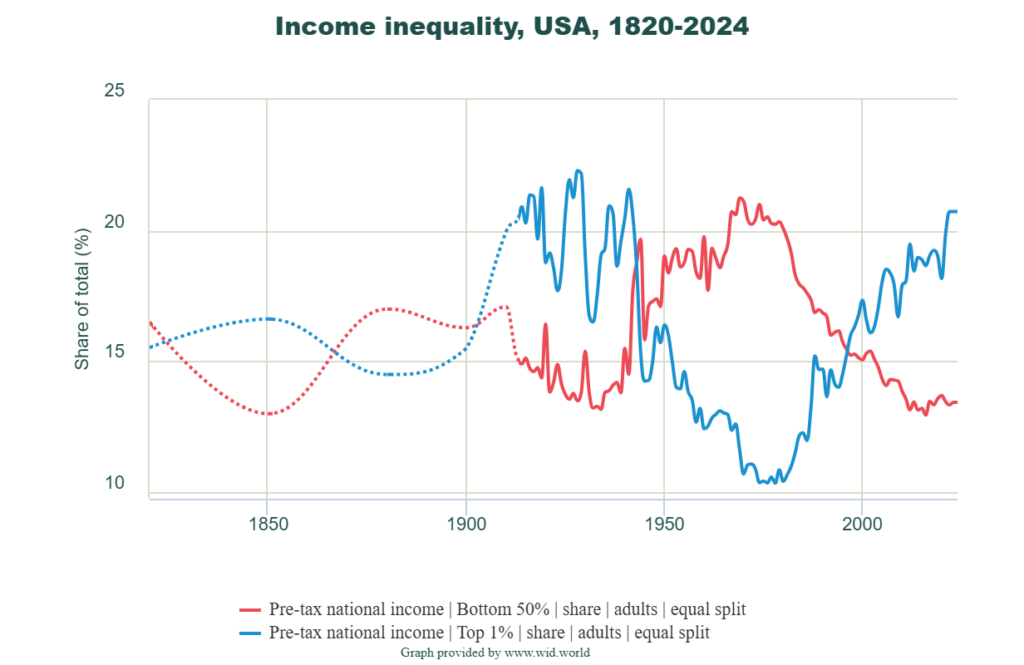
The graph illustrates how the concentration of wealth peaked in the mid-1920s before the Wall Street crash. Thereafter the New Deal and the compact between labor and capital in the post-World War 2 period resulted in the highest income share ever flowing to the bottom 50% and conversely the lowest share flowing to the top 1%, hitting extremes in around 1980. At that point a combination of globalization and corporate-friendly policies reversed the trend.
Turchin contends that the wealth pump has now been running in America for roughly two generations. Wages for most workers have stagnated in real terms even as productivity and elite wealth climbed. The share of income of the bottom 50% is at its lowest levels ever. At the same time more college graduates, more law degrees, and more MBAs have vastly outpaced the number of positions those credentials are supposed to lead to.
The result, in his telling, is a growing population of what he calls frustrated elite aspirants: people with the education and ambition to expect entry into the elite, but no seat waiting for them. Some of these frustrated aspirants become “counter-elites” — figures willing to break institutional norms and mobilize popular anger to gain power that the existing system won’t hand them through conventional channels.
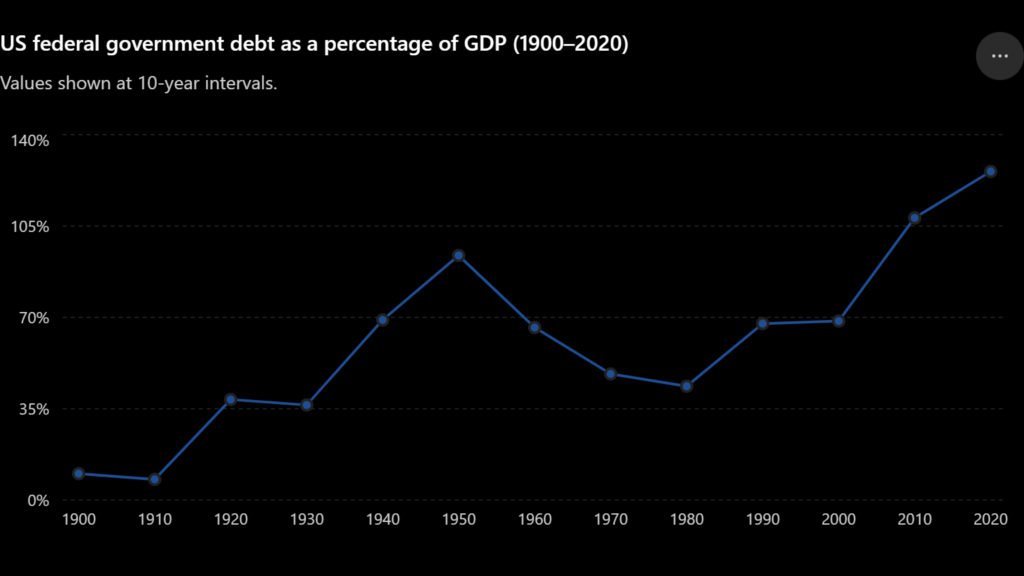
The conditions of popular immiseration and elite overproduction currently appear to be in place in America and other western countries. What about other factors? Is the state running out of money? The accompanying graph shows US government debt is even higher than immediately after World War 2 and currently sits at around 120% of GDP.
Geopolitical pressure? We have the rise of China, and war in the Middle East and Ukraine. Climate Change? Unprecedented warming, wildfires in North America and Europe. The rapid development of AI also points toward further concentration of wealth.
Turchin says this is a trajectory, not a certainty. Historically, some societies have pulled back from the brink through reforms that closed the wealth pump, expanded or reduced elite positions, or otherwise relieved the pressure before it turned violent.
These historical off-ramps are reason for cautious hope, but the clock is running.
Disclosure: some of this article text was generated by Claude Sonnet 5 AI
The writer is a co-author of Court of the Grandchildren, a novel set in 2050s America.
Main image credit: Wikiimages via Pixabay
For posts on similar themes, consider:
Every Time History Repeats the Price Goes Up