
Imagine your house had a thermostat that measured not the temperature, but the rate at which heat was building up inside, even before you felt it. That’s essentially what scientists track when they measure Earth’s Energy Imbalance, or EEI. And the latest readings, released this year, are the highest ever recorded.
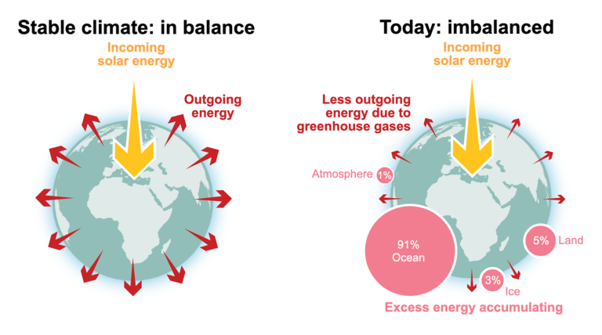
Every day, sunlight pours into our atmosphere, and Earth radiates some of that energy back out to space as heat. In a stable climate, those two flows roughly cancel out. But they haven’t been canceling out for decades. Greenhouse gases trap extra heat before it can escape, so more energy comes in than goes out. That leftover, measured in watts per square meter, is the EEI – a tally of how much extra heat the planet is stockpiling.
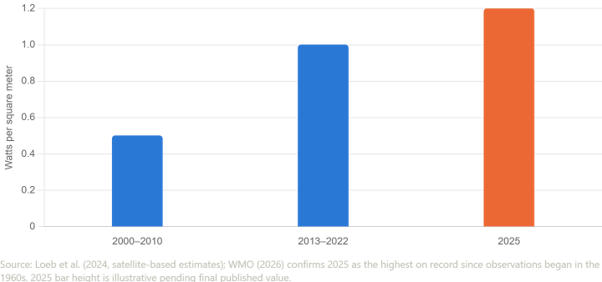
A major scientific update published this year, led by climate scientist Piers Forster and dozens of collaborators, found that Earth’s energy imbalance has more than doubled since the 1976–1995 period. A separate NASA-satellite analysis, using the CERES instruments that have measured Earth’s radiation budget since the 1990s, found something similar over a shorter window: the imbalance roughly doubled from about 0.5 watts per square meter in the first decade of this century to about 1.0 watts per square meter in the decade that followed. The chart below shows that climb, with 2025 a new record.
The World Meteorological Organization’s State of the Global Climate report added EEI as an official climate indicator for the first time this year which is a sign of how seriously the scientific community now takes it. Their report found the imbalance has increased since satellite records began in 1960, especially over the past 20 years, and agree that the EEI reached a new high in 2025.
Researchers point to two main culprits for the EEI. First, obviously, rising greenhouse gas concentrations, which reached their highest levels in at least 800,000 years in 2025. Second, something more counterintuitive: as countries clean up air pollution, particularly sulfur dioxide from ships and factories, they’re removing tiny particles that used to reflect some sunlight back to space. That decline in aerosols is actually increasing Earth’s energy imbalance, because those particles had been temporarily masking some of the greenhouse warming. But scientists are careful to note this isn’t an argument against cleaning up pollution.
Perhaps most unsettling: the imbalance is growing faster than climate models predicted. A gathering of researchers at Germany’s Max Planck Institute for Meteorology earlier this year confirmed that the rate of change is outpacing expectations from the last major IPCC assessment.
Almost none of the accumulated extra heat stays in the air. More than 90% is absorbed by the oceans, where it drives marine heatwaves, accelerates ice melt, and contributes to sea level rise. Only 1% of the excess heat is stored in the atmosphere.
Unlike a single hot spell, the EEI can’t be dismissed as normal weather variation. It’s a direct measurement of the planet’s energy budget – akin to checking a bank balance instead of just watching one paycheck. As long as it stays positive, temperatures, sea levels, and extreme weather will keep trending in the same direction. The disturbing observation is that not only is the EEI staying positive, but it’s actually increasing, which implies an accelerating increase in temperature and extreme weather events. An outcome that is increasingly obvious to anyone who cares to look.
Disclosure: much of this article’s text was generated by Claude Sonnet 5 AI
The writer/editor is a co-author of Court of the Grandchildren, a novel set in 2050s America.
Main image credit: Syaibatulhamdi via Pixabay
For posts on similar themes, consider:
References
- Forster, P.M. et al. (2026). Indicators of Global Climate Change 2025. Earth System Science Data, 18, 3889–3933. https://doi.org/10.5194/essd-18-3889-2026
- Loeb, N.G. et al. (2024). Observational Assessment of Changes in Earth’s Energy Imbalance Since 2000. Surveys in Geophysics. https://doi.org/10.1007/s10712-024-09838-8
- World Meteorological Organization (2026). State of the Global Climate 2025. https://wmo.int/news/media-centre/earths-climate-swings-increasingly-out-of-balance
- Andrew, R. et al. (2026). Earth’s energy imbalance has doubled — here’s why that matters. The Conversation. https://theconversation.com/earths-energy-imbalance-has-doubled-heres-why-that-matters-284877
- Carbon Brief (2026). Guest post: How a record-high ‘energy imbalance’ is driving global warming. https://www.carbonbrief.org/guest-post-how-a-record-high-energy-imbalance-is-driving-global-warming
- Max Planck Institute for Meteorology (2026). Why is Earth’s Energy Imbalance Growing? https://mpimet.mpg.de/en/communication/news/why-is-earths-energy-imbalance-growing