There are multiple signs that the urgency of climate action in developed countries is receding. Is it because of growing geopolitical unrest? Concerns over the economy? Trumpian claims of a hoax? Or just plain climate fatigue? Whatever the reasons, it is reminiscent of the period straight after the Global Financial Crisis when the world’s attention turned to financial survival, and to the early 2020s when the COVID pandemic was top of mind.
In this post I summarize the excellent reporting in The Economist edition of 2nd August 2025 that provides some insights into why climate action may be stalling.
The lead editorial provides the overview:
“Curbing climate change was never going to be easy. The fundamental energy balance of a planet cannot be changed overnight; nor can a fossil-fuel-based economy that serves billions of people be replaced without furious political objections. But today the problem looks particularly hard.”
In Europe the war in Ukraine has spurred growth in defence budgets, squeezing spending on green policies which are also facing renewed political opposition.
Europe’s hard right has come to loathe renewable energy. It is unreliable, they say, jumping on any grid mishap to prove their point regardless of whether it actually does. For them, it imposes energy bills on consumers they cannot afford, and costs on businesses that make them uncompetitive. And even if carbon-dioxide emissions matter, those from Europe are so small that its unilateral actions count for nought, they insist. In their view, the whole idea of fixing the climate is considered “woke”.
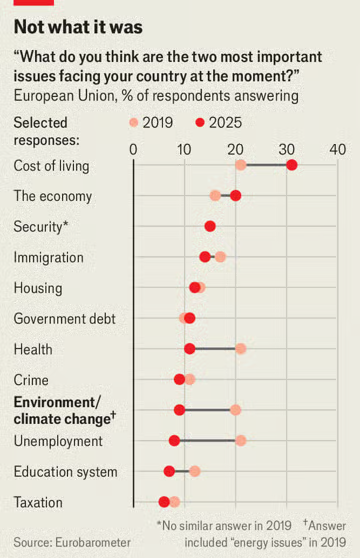
This perspective is being increasingly shared by the centre-right, perhaps in view of the changing sentiments of voters. Cost-of-living and security concerns have pushed down the importance of climate change as an issue to 9th ranking in a recent voter poll.
The latest EU target is to cut emissions to 55% by 2030 and net zero by 2050. It is projected that if current policies are retained, the cut achieved by 2030 will be 52% – a credible result. The concern is that future cuts will fall more heavily on households and businesses which may pressure policy makers to blink.
Another risk is the proposed new European emissions trading scheme for carbon credits called ETS2 (supplementing the existing ETS) which is set to launch in 2027. It will price emissions in building and transport and is likely to be unpopular.
The Economist believes that “Europe’s elites have sought to make action on climate change a part of what it is to be European. If they want that identity to take root, they urgently need to find ways to convince their fellow citizens that it is worth it. And they must rebuild support in a way that makes steady progress hard to reverse, even if that progress is not as fast as would be ideal.”
Sensing the political winds, some big global firms have gone quiet about green action. Others, such as BP and Jaguar Land Rover have abandoned them altogether. Financial institutions are also backsliding. HSBC, Goldman Sachs and Morgan Stanley, among others, have dropped out of the Net Zero Banking Alliance.
Part of the problem in America is Republican senators suggesting that joining a green alliance could breach antitrust rules. In January, ten state attorneys-general threatened legal action against America’s biggest financial firms if they did not change their climate and diversity policies.
The consequence of all this is that companies that are continuing to take action to decarbonise have grown more reluctant to showcase their efforts.
It’s not all bad news however, as data published in March 2025 by PWC show that of 4,000 firms reporting climate commitments, only 16% dialled back their goals, while 37% became more ambitious. Further, two-thirds of the companies with targets were on track to meet them.
The Economist concludes that “the fact that many (companies) are quietly persevering with decarbonisation (means) that they realise that taking action is beneficial to their bottom lines, no matter what politicians say or do.”
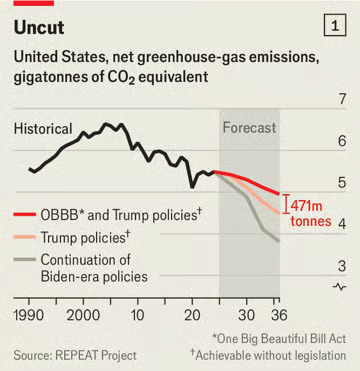
Meanwhile, the biggest legislative changes on climate action are occurring in the United States. Congress has passed Donald Trump’s One Big Beautiful Bill (OBBB) rescinding many of former President Biden’s climate-friendly energy initiatives. The result is an increase in forecast emissions.
Trump has gutted the US Environmental Protection Agency and escalated his attacks on climate science. The edition’s invited opinion piece by Ralph Keeling of Scripps Institution of Oceanography believes that Trump’s “drill, baby, drill” policy needs more climate monitoring and tracking, not less.
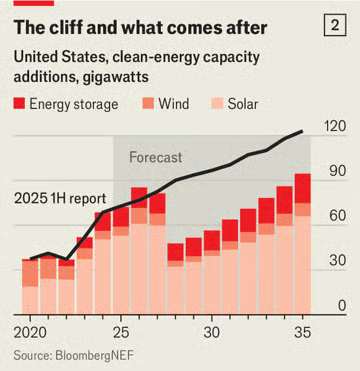
A careful analysis of the OBBB indicates a more nuanced outcome than one might expect from the headlines. Tax credits for solar, wind and green hydrogen are being phased out by 2027/28 which many predict will result in a surge in such projects in the short-term to beat the deadline. Thereafter a sudden drop in clean-energy capacity additions is forecast.
The biggest negatives in the bill are for the Electric Vehicle (EV) sector. Tax credits are being removed from September 2025. The OBBB also makes it easier for fossil-fuel firms to drill on federal land and expanding that such land available.
However, there are some surprising incentives to transition away from fossil fuels. Nuclear and geothermal energy, both clean sources of baseload electricity, have retained the tax benefit status. As have schemes that remove carbon dioxide from the atmosphere. Furthermore, the tax credits for batteries are retained. Many predict solar developers will reorient toward energy storage to “stay alive until ’29.”
By 2035 Bloomberg NEF forecasts new clean energy project additions hitting an all-time high which could be more sustainable because it will be based on pure cost advantages and new business models.
However, a malevolent Trump could readily forestall many initiatives allowed by the OBBB through directives to Treasury which can sprinkle sand into the gears of approval, and significantly reduce the number of forecast projects.
Many industry insiders predict increasing energy costs for households and businesses will eventually re-incentivise wind and solar. In the meantime, the US will inadvertently hand China an unassailable lead in EV markets, solar and other renewable technologies.
The writer is a co-author of Court of the Grandchildren, a novel set in 2050s America.
Main image and chart credits: The Economist
For posts on similar themes, consider:
The Race to 100% Renewable Electricity